

Back in the UK, and back to some of my favourite spots. Today, I decided to go to The Hoxton in Holborn, where this newsletter is brought to you from.
I love this place dearly. It takes me back to my LSE days, when friends and I would gather in the lobby to talk nonsense and get some work done (or at least, try to). It was open to the public and they had free WiFi—what more could we want?
I think about this lobby often. It lent itself well to the communal aspects of getting a degree. You know, shared Word docs, badly timed crushes, existential spirals over job applications. It’s where we celebrated, sulked, flirted, cried, and—eventually—convinced ourselves that a midweek order of wine and fries meant we were thriving.
It really was the lifeblood of our grad lives. And now, sitting in it again, I’ve been thinking about hotel lobbies more broadly.
To me, a lobby is much like a city in the sense that it’s meant to be a threshold of sorts. It must offer possibilities of people-watching as well as moments of connection and isolation in equal measure.
However, I can’t help but feel like so many hotel lobbies these days are stylised nothingness. Beautiful on entry, emotionally vacant five minutes later.
The intention is there. You’ve got the right sofas and curated artwork. But for all that, there’s no real story being lived out, and I find myself asking, “How does this space want to make me feel?”
I hold The Hoxton’s lobby to a high standard because it’s earned. It’s used repeatedly by people like us, who give it our time and our rituals.
From a design standpoint, what this space gets right is range. You walk in through automatic sliding doors, and it’s wonderfully open-planned. There are low-slung sofas along with upright armchairs. Coffee tables, dining-height tables, and then smaller, rounder ones. Sockets are plentiful and positioned exactly where you need them to be, saving you from hovering awkwardly over a stranger, as you ask them to make room for your device.
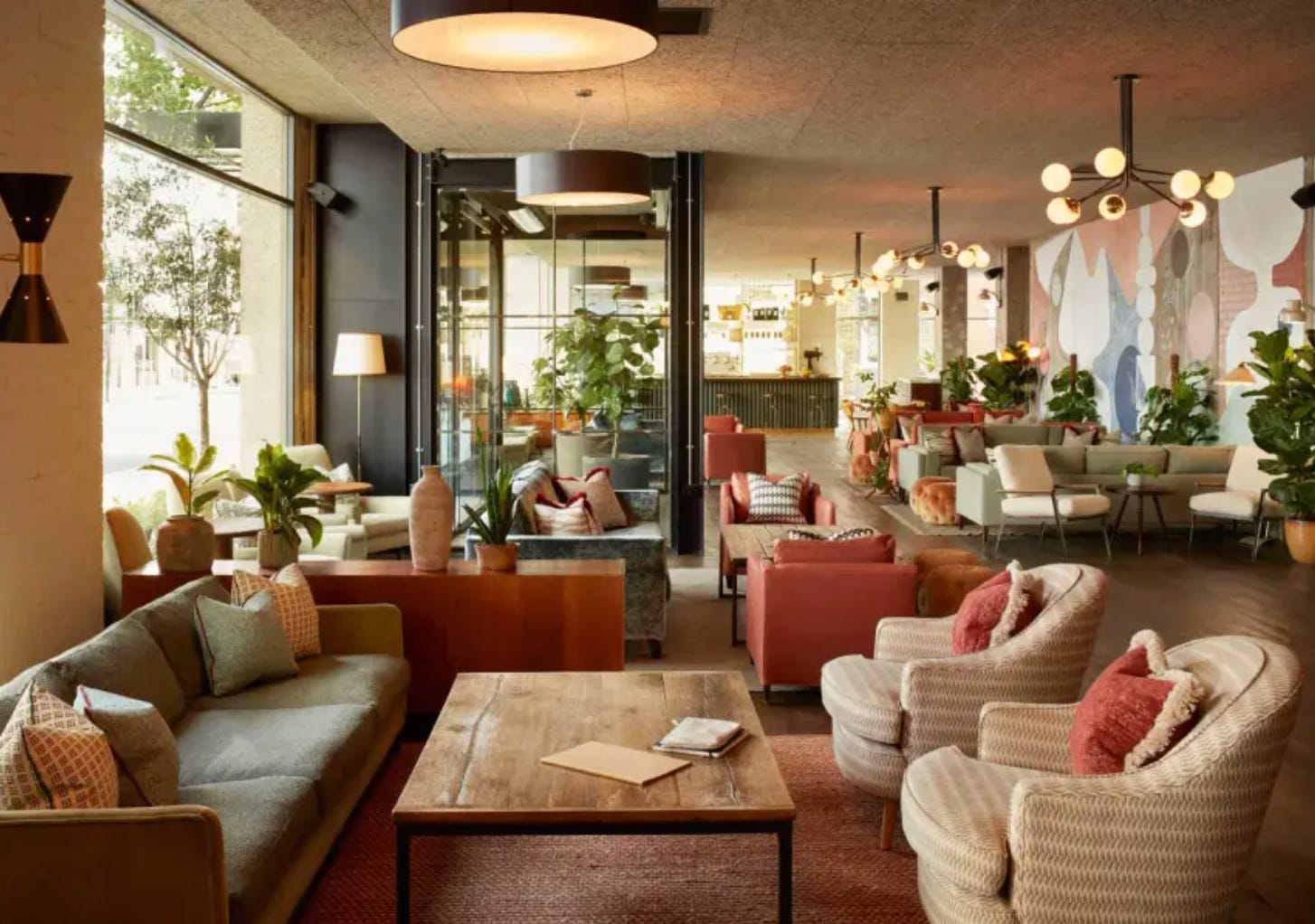
Essentially, this is a layout that doesn’t force a vibe. It simply absorbs whatever you bring to it. You could be on a date, midway through a deadline, killing time, or all three. It doesn’t matter, it all works.
Not every hotel needs to follow this model, of course. Context is important.
In a well-connected part of the city, like Holborn, where there are offices, universities, freelancers and locals, it makes sense to design a lobby that can hold multiple lives at once. But that same logic doesn’t apply to a rural retreat or a resort, for example.
Let’s say you’re tucked away in wine country or deep in nature somewhere. The lobby might just need to be a place to wait or where you can sit still for five minutes before heading out again. It’s a preamble, not a destination. And that’s fine, but even then, it should feel considered.
The real issue I see is when lobbies are designed with little clarity about what they’re for. And when they don’t know what they’re for, they end up being oddly performative or totally vacant.
After all, spaces designed to avoid alienating anyone rarely end up holding anyone.
This matters, especially if you’re a hotelier, or thinking like one.
The lobby is one of the few hotel spaces that exists in public view without a paywall (most of the time). That alone gives it weight. It’s a prime chance for the hotel to show what it’s made of and to signal how it sees itself, and whether it has any real perspective at all.
Is it a third space? A buffer? A backdrop for social life? A driver of dwell time? A soft landing before check-in?
If a lobby doesn’t know the answer, it’s just square footage with chairs—a lost opportunity.
That opportunity is more relevant than ever, as we’ve collapsed the categories of work and life. People want to move through their day without having to formally ‘switch modes’, and most hotel lobbies are yet to catch up.
A communal table does not make a workspace (I’m looking at you, Kimpton Hotel Enso), nor is a good playlist a sign that people will linger. So while the use cases for a lobby have multiplied, the design logic hasn’t.
And it’s not always about the amenities, although, they obviously help. It’s imperative that hotels understand that people want to belong to this type of space without fully committing to it. That’s the draw—if a lobby becomes somewhat of a liminal companion.
Anyway, that’s where my head’s at, sitting here, watching others around me chitchat. I love it. I love it so much.
Thank you for reading! It truly means a lot. If it sparked something, please tap the heart and pass it on. If it didn’t, well, there’s always next Friday. See you then!
Keep publishing!
This I have a LOT of time for!
Your note on a balance of connection and isolation is key! Good service - but not intrusive or intimidating.
But in terms of design - it’s scent, it’s texture, it’s acoustics. Comfort. For those checking in and those chilling out. So many spend so much money and still get it wrong!