

There are countries that make you feel like you’re seeing well into the future. Canada, unfortunately, is not one of them—at least, not where hotels are concerned. And it makes me sad to admit that.
There’s something hesitant in the design language here. It’s as if the very notion of aesthetic ambition might offend someone, which we know the Canadians would hate to do.
This week’s newsletter is a small love letter, or rather, a gentle critique to a place that could be doing so much more.
WHAT NO ONE TELLS YOU ABOUT CANADIAN HOTELS
There’s an unexplained gap in Canadian hospitality. Not in the landscape—the country has that in spades. Nor is it in the traveller—there are plenty of discerning people booking trips across Vancouver Island or Nova Scotia. No, the gap is in the hotels.
When I was looking into this year’s hotel openings in North America, it struck me how little was happening on Canadian soil. Barely anything new! And nothing particularly exciting.
Disappointing? Yes. Surprising? No.
Tourism hasn’t exactly bounced back since Covid, and a lot of Canadians themselves will tell you it never really took off in the first place.
This was made clear in a rather depressing Reddit thread I found myself knee-deep in:


TL;DR this person’s succinct response says it all:

For a country this vast and this beautiful, Canadian hotels often feel like they’re playing catch-up. There’s nothing garish or try-hard about them, but they seem faintly outdated. It’s as if they’re still designing for tourists who just want a scenic view and clean sheets, rather than those who notice the shape of the bedside lamp or the patina of the floors—which you, dear reader, do.
In short, I believe Canadian hotels are a few steps behind what they could be, and I don’t think anyone’s really talking about it.
My sentiments fall under four key points:
The design lag
Canada has some stunning nature but oddly few design-forward hotels. Why is it so hard to find an actually stylish place to stay in, say, Banff or the Maritimes?The regulation effect
Canadian hospitality is shaped by strict licensing, unionised hotel workforces, or a more risk-averse approach compared to the US and Mexico.The missed opportunity
Canada has all the raw material, i.e. landscape, culture, architecture, but somehow the hotel scene hasn’t kept up with its culinary or style renaissance.The ‘under the radar’ treasures
Maybe there is a soft reveal, which I’m awaiting to discover. They are doing something interesting, but they just don’t get the same love as their North American counterparts.
Before we go any further, I just want to be clear that I’m not trying to throw shade at the country that gave us Céline Dion. It’s more of an observation that comes from paying close attention to what’s happening elsewhere.
If you’ve travelled across North America recently, you’ll know what I mean. In the US, the boutique hotel boom has matured into something quite tasteful. It’s less about neon signs and Edison bulbs, and more about mood and emotional pace.
Mexico, for its part, has become a design pilgrimage of sorts. Every few months, a new stay will open and it feels exceptionally soulful without being laboured.
In Canada, sadly, you’ll still find a lot of plaid. A lot of beige. A lot of ‘contemporary rustic’ that feels like it was last updated around 2011. It’s not offensive, it’s just… uninspired.
There are reasons, of course, as I’ve listed above. Canada is famously risk-averse when it comes to property. Zoning laws are strict and building costs are high. Culturally, there’s more appetite for the dependable (read: Hilton) than for experimental stays that might challenge the status quo.
There’s also the legacy effect. Hotel brands, like Fairmont, still dominate perception. They’re grand, yes. But they haven’t exactly evolved.
And so, the Canadians underplay. Aesthetic confidence is mistaken for pretension, which is noble, I suppose, but also limiting. Because if there’s one thing design-led hospitality requires, it’s conviction. You have to believe that a space can shape memory. Because it does.
Indeed, there are exceptions. The June Motel had its moment, helped along by a Netflix show. It was youthful, fun. It knew how to brand itself. Elsewhere, The Drake is still holding court in Toronto, although its charm feels more local than exportable. Fogo Island Inn is an absolute marvel, but again, it’s the exception, not the rule.
While there are murmurs of newer projects in coastal BC and wine country, the pace feels glacial. The direction remains unclear.
What’s frustrating isn’t what exists. It’s what doesn’t. And there’s so much potential!
Imagine a hotel in Charlevoix that feels like the Canadian answer to Ett Hem. Or consider a surf retreat on Tofino’s coastline. Or even a Montreal townhouse that could rival the best of Paris.
But for now, the Canadian hotel scene remains more polite than provocative. More serviceable than special. I don’t think it’s broken per se, but it’s certainly not thrilling.
And that’s a shame. Canada is a country that totally deserves a stronger emotional translation in its hotels. It could do well with spaces that reflect the nuance and generosity of its people.
Forgetting any structural challenges, the desire is there. The audience is more than ready. The only thing missing, really, is bullish commitment.
THE STAYS TO BOOK
Despite what I said, there are some bright spots if you know where to look.
In the Laurentians, Farouche is doing something quite adventurous with its angular micro-cabins and off-grid energy.
Similarly, Arcana, with its mirrored cabins hidden in the woods of Ontario, has also stirred something. It leans into the sensory side of solitude—forest walks and silence.
Then, there’s Wander the Resort in Prince Edward County, which gets a lot of attention, and, to its credit, has followed through. The branding is tight, and the lakefront cabins manage to feel breezy without being basic.
But notice how all of these places are essentially cabins?
Which is telling. It seems the only context in which Canadian hospitality is allowed to experiment is when it’s cloaked in the language of the wilderness. Urban hospitality, by contrast, remains weirdly untouched. It’s conservative and clunky.
Anyway, not to get too bothered, here are a few other hotels I’d book:
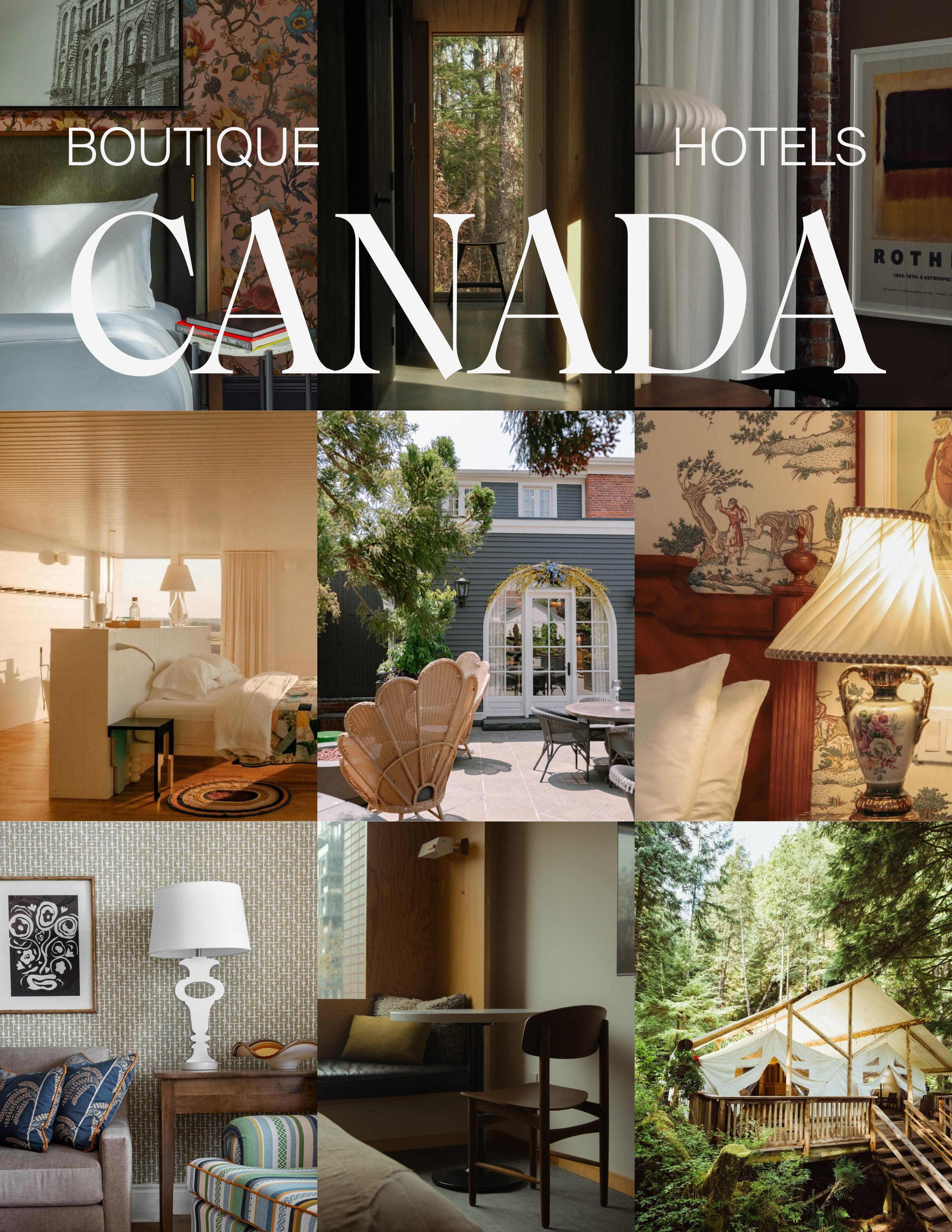
As always, a Google Maps link to all the hotels mentioned in this post (NB: there’s no pin for Arcana or hinterhouse, given their secretive locations).
I only wish there were more places to include. But it’s hard to find a stay that prompts a real visceral reaction beyond ‘that looks nice’. So for now, this list will have to do.
I’ll keep scouring, of course. If there are any hidden hotels out there, I intend to find them.
In the meantime, I’ll catch you next Friday—same room, different view!