

Today’s a ramble. I’ve been stuck on ‘good design’, which is a phrase everyone in the industry uses and nobody will define. I’m not going to manage it either. Another week, perhaps.
What I keep dwelling on, though, is whether it survives repetition. Boutique hotels are built on personality, but personality is expensive and resistant to scaling. Most of us consider that settled and move on.
But a few weeks of digging says it isn’t settled at all, and we’ve been debating about the wrong thing.

Unique design can absolutely scale. People have pulled it off before, and if you look closely, they’ve even left us a breadcrumb trail showing exactly how.
The more interesting, if slightly uncomfortable, question is what actually happens to the word ‘unique’ once it’s been put through the wringer. Also, why do we end up feeling a little disappointed by what’s left?
If you’re looking for a textbook example, look no further than Ace. Roman and Williams took on New York in 2009. Universal Design Studio, alongside hotel specialists EPR, handled London Shoreditch in 2013 (RIP). Commune did the Atelier Ace–era American Trade Hotel in Panama, then Kyoto with Kengo Kuma. Studio Shamshiri did Maison de la Luz in New Orleans, the group’s luxury spin-off (also RIP). And Flack did Sydney.
Brad Wilson, who runs Ace Group International, has been open about preferring designers with no prior hotel experience. It’s a habit he traces to putting Rockwell Group on the W New York and Yabu Pushelberg on the W Times Square—their first hospitality jobs.
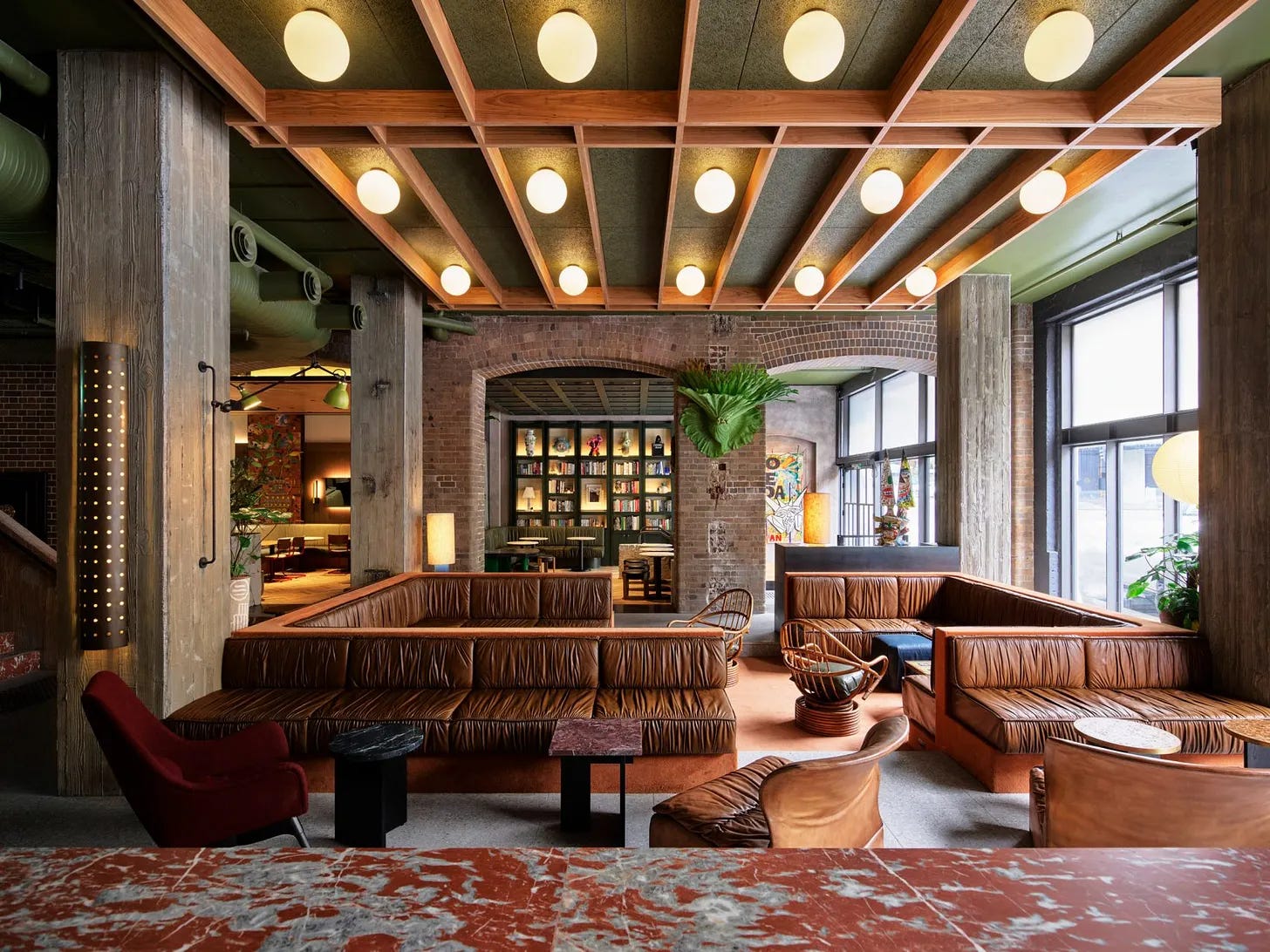
What’s being repeated across these cities isn’t a look at all, but a way of commissioning. That, if you ask me, is the only thing in hospitality design that truly scales—the habit of who you invite to the table.
Visit any of them and you know within seconds whose hotel you’ve landed in. What one write-up called a mélange in 2013—grunge, hip hop, letterpress, army surplus, vintage vinyl, steampunk, machine-age salvage, all the trappings of the Beat Generation—had, they reckoned, become a design movement in itself. Which is really just a polite way of saying it became a template anyone could pinch.
But a template isn’t some neutral thing you pass around and expect wildly different results. It’s a set of preferences baked right into the design process.
This is where the conversation tends to go off piste. The kind of recognisability I’m talking about is branding, not design, and it never has been.
See, branding is a promise. It’s a reflection of the operator’s judgement. Design is how that promise is manifested in any given building, with all its idiosyncrasies. They’re completely different jobs, on completely different timelines, handled by completely different people. But the industry routinely expects interiors to shoulder the entire brand identity, simply because there’s nowhere else for it to go.
If you ask a brand to show up in the furniture, that’s exactly where it’ll show up. Furniture is easy to repeat, and the sameness isn’t because designers lack imagination. It’s just what happens when you make the most visible, most photographable layer do all the heavy lifting for recognition.
But even on its own terms, it’s the wrong layer to obsess over. Take Ace Shoreditch. The building began life as a Crowne Plaza. The timetable and budget were both tight, so the bedrooms, as the executive architects put it, got a ‘soft refurbishment’ across all 258 rooms, while the façade and public areas were remodelled. In other words, all the Shoreditch-ness was in the lobby, but the room you actually slept in was just a chain hotel, only slightly reimagined.
Alas, that’s where the money goes. Furniture, fixtures and equipment make up about 8 to 12 per cent of the total development cost, and interior design fees are just a fraction of that. Projects almost always run over budget, and when the contingency fund dries up, it’s the decorative layer that gets trimmed, simply because it’s the only bit you can trim without having to redraw plans.
Then, of course, it all wears out. Most FF&E lasts seven to ten years, mattresses and high-use items even less, and any well-run hotel is already setting aside a small percentage of revenue each year to replace it.
So essentially, the layer that makes a place look unique is the cheapest, the last to be specified, the first to be cut, and replaced within a decade. Meanwhile, the floor plan is expensive and standardised.
Guests are quick to remember FF&E, and that’s why a dozen design-led hotels, none with the same objects, still blur together in your memory.
If that’s the case, then the real design choice is the building itself—and that decision sits with the brand, not the design studio.
In my view, the technology arguments don’t help here and are best set aside. A room with adjustable lighting and a guest-chosen soundtrack, for example, might sound cute, but they’re not unique; they’re just customisable. True individuality means the room has its own character, and if a hotel lets you change everything to your own taste, it’s almost as if it’s admitting it doesn’t have any taste of its own.
This new trend of rotating digital art is the same thing. And I can’t stand it.
There are perfectly good reasons for standardising hotels, though, and I can accept the practicalities. Plans get repeated because of the less glamorous things, like plumbing, fire exits, accessibility, housekeeping routines and so on. Oddly shaped rooms are only really loved by people who don’t have to sell them. And guests themselves are less predictable than we’d like to think. They want the shower to be the same everywhere, but heaven forbid the lobby doesn’t surprise and delight them.
So the fix isn’t to design harder. It’s to stop asking the interiors to do the brand’s job, and give recognition somewhere else to live—further upstream, in the decisions taken long before a designer gets to work.
If you look through Ace’s portfolio, their signature comes down to three things:
They hire people who’ve never designed a hotel before.
They buy unusual old buildings.
They make the ground floor public.
These three things are why Ace feels like Ace regardless of the city and whatever the furniture is doing. And while guests think they’re seeing a consistent look, they’re actually responding to a consistent judgement.
This approach is definitely harder, and hotel groups aim for a visual signature because it’s the only bit of sensibility that survives once the founder has moved on.
There’s a limit to this, of course. The risk is never that the hotels look too different from one another. It’s that nothing holds them together underneath.
So the answer is yes, with a caveat. Unique and individual design scales fine. The sameness we blame on designers is really a branding decision, and if you move the brand where it belongs, hotels are free to look dissimilar.

MIND
It’s so weird how an illuminated screen can feel more like home than the environment you’re physically in. That’s where I’ve been hiding out lately. The homesickness has sneaked in, probably because I didn’t make it back to England this summer, and so I’ve found myself roaming further into the virtual ether. This is what happens when your family and oldest friends are based elsewhere, across several time zones. The distance can become unbearable. So, I log on. I scroll, I refresh, and I leave silly comments as I hunt for digital pockets where their lives overlap with mine. I now have a daily ritual where I try to narrow this gap. I turn to the internet to pass the time. And I can’t tell if that’s ridiculous or just a natural way of living.
THINGS
I love reading, but I’ve noticed that this year, I’m not getting through nearly as many books. As a child, I would devour them over the summer holidays, mostly because with unreliable internet, there wasn’t much else to do. I want to say it’s easy to pick up a book before bed, but it’s not. I have to force myself to close the laptop or put down my phone, and that’s a whole saga I won’t get into here. I used to be firmly anti-Kindle. Even my sister, the biggest bookworm I know, was against it—until she got one earlier this year, and now she’s a total convert. So I’m curious: do you have a Kindle? And do you actually enjoy using it? Are you reading more, or less, because of it?
I saw a video recently where a girl was poking fun at people still wearing Whoops after a year (I wish I could find it again, but I’ve lost it). Her point was that once you’ve got a sense of how your body ticks, it’s probably time to let go of the wearable tech. And, I can’t believe I’m saying this, I think I agree. I’m not here to tell anyone to wear or not wear a Whoop. I tried it, enjoyed it, but I think I’m ready to call it quits after this year’s subscription ends. This doesn’t mean I’m about to rush out and buy an Oura ring, either. The most valuable part has been learning to pay attention to my body and keeping tabs on things like my cycle. But with my tendency to obsess, it’s probably not the best idea for me to be constantly checking and tracking. This isn’t a forever goodbye, though. Who knows, maybe in a few months I’ll be back to it.

Thank you for reading and supporting The Other HAFH. I’ll catch you next week.
Ace's real signature wasn't the furniture ....it was who they invited to the table.
What you are writing about the Ace js true- it came to Portland first and the open lobby concept to the public was so fresh. And when it opened in NYC after that, it was a new third space before that was a thing- becoming local and a place I would regularly go with friends. And you can still see the DNA as the budget increases and even the style refines because of those moves you outline.