

The Wall Street Journal published a piece last year on how hotels are doing away with wardrobes. Cost-cutting, obviously. But that’s okay. The wardrobe doesn’t worry me. What I’m more concerned about is that hotels are doing away with desks. And that’s what I want to talk about today.
The desk isn’t trivial. It comes with a whole set of meanings and values, and I believe keeping it or removing it says a great deal about what kind of guest you’re pitching to. Of course, whether that’s a good or a bad thing is subjective.

Once upon a time, the hotel room was a fixed format. You’d swing open a weighty fire door, skirt past the bathroom (either to your left or right), and step into a bedroom dominated by three immovable objects: the bed, the wardrobe, and the ever-present executive desk.
That desk was a wonderful analogue workstation, sturdy enough to support a hulking cathode-ray television, a stack of directory binders and a landline. For the mid-century business traveller, it was the perfect space to sit upright and tackle a pile of paper receipts.
But the room was already starting to change, and quickly.
See, furniture is never just furniture; it’s a snapshot of its time. The old hotel desk took up a large portion of the room, demanding nearly a metre just to pull out the chair. That’s about 15 or 20 square feet sacrificed to a single purpose. And as our tech shrank from clunky desktops to featherweight laptops, the dedicated workspace began to look a little suspect.
Today, in mid-market and select-service hotels, every square foot has to earn its keep. If leisure or ‘bleisure’ guests barely glance at a desk, operators realise it’s better to swap it for a wall shelf, trimming the room’s footprint to pack more keys onto the floor.
Inevitably, that pushes things into the lobby.
A traveller holed up at an in-room desk isn’t spending any money. But if you make the in-room setup just uncomfortable enough, they’ll drift down to the communal spaces, which are cleverly designed to squeeze revenue out of every hour via flat whites or cocktails.
The migration of labour from private quarters to public ones was led by lifestyle brands like Ace Hotel and The Hoxton, widely credited with repositioning the lobby as a cultural hub, featuring communal tables lined with open MacBooks.
The hotel is effectively charging you for a bed upstairs while operating a subscription-free co-working space elsewhere.
To be fair, and I’ll play devil’s advocate here, the spatial shuffle isn’t just a win cost-wise; for many travellers, it’s a welcome evolution.
In urban micro-hotels, space is a luxury, and getting rid of a rarely used desk frees up room for a larger, more comfortable king-sized bed, a more spacious bathroom, or simply more breathing room. And for guests who don’t want to work during their stay, a traditional desk is just dead space they’ll have to walk around.
Not to mention, the rise of remote work has created an epidemic of isolation. Travel can be lonely, and staring at a hotel room wall exacerbates that. Open, vibrant lobbies satisfy any psychological desire for the productivity boost that comes from working alongside others.
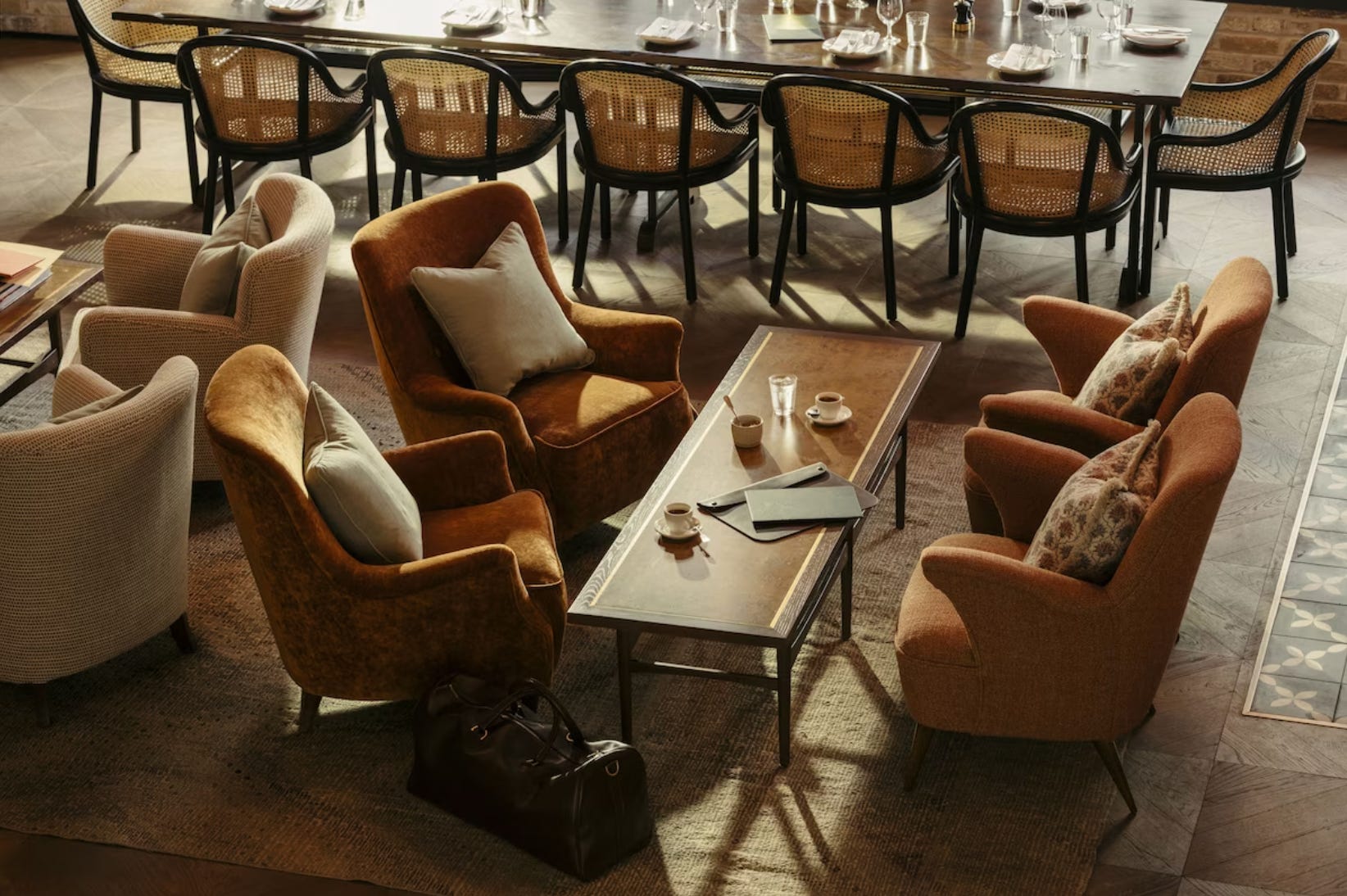
For guests who choose to stay in their rooms, however, there’s a physical toll, as the desk is replaced by a shallow, floating ledge or a tiny circular table. The room actively rejects productivity, and while the idea of working from a plush armchair or balancing a hot laptop on a duvet seems nice, it’s uncomfortable as hell. A simple catch-up on emails turns into a physical battle against neck strain and lumbar fatigue.
The death of the desk isn’t universal, though. It’s fractured by demographics.
In hotels aimed squarely at the remote-work crowd, the desk is actually making a comeback. Designers are calling it ‘workspitality’, and a token desk in the corner with a lounge chair no longer cuts it.
On the back of ‘work-from-hotel’ demand, the in-room workstation has returned, now kitted out with standing desks and multifunctional surfaces, while long-stay brands like Zoku build their lofts around desk alcoves for guests who are there to work as much as to sleep.
Ultra-luxury hospitality plays a different game altogether. When you’ve got a suite that can run past 600 square feet and an eye-watering nightly rate, space optimisation matters less than intent. In grande dame city hotels like the Ritz Paris or Claridge’s London, for example, the executive desk remains a sacred statement piece. Patrons expect it.
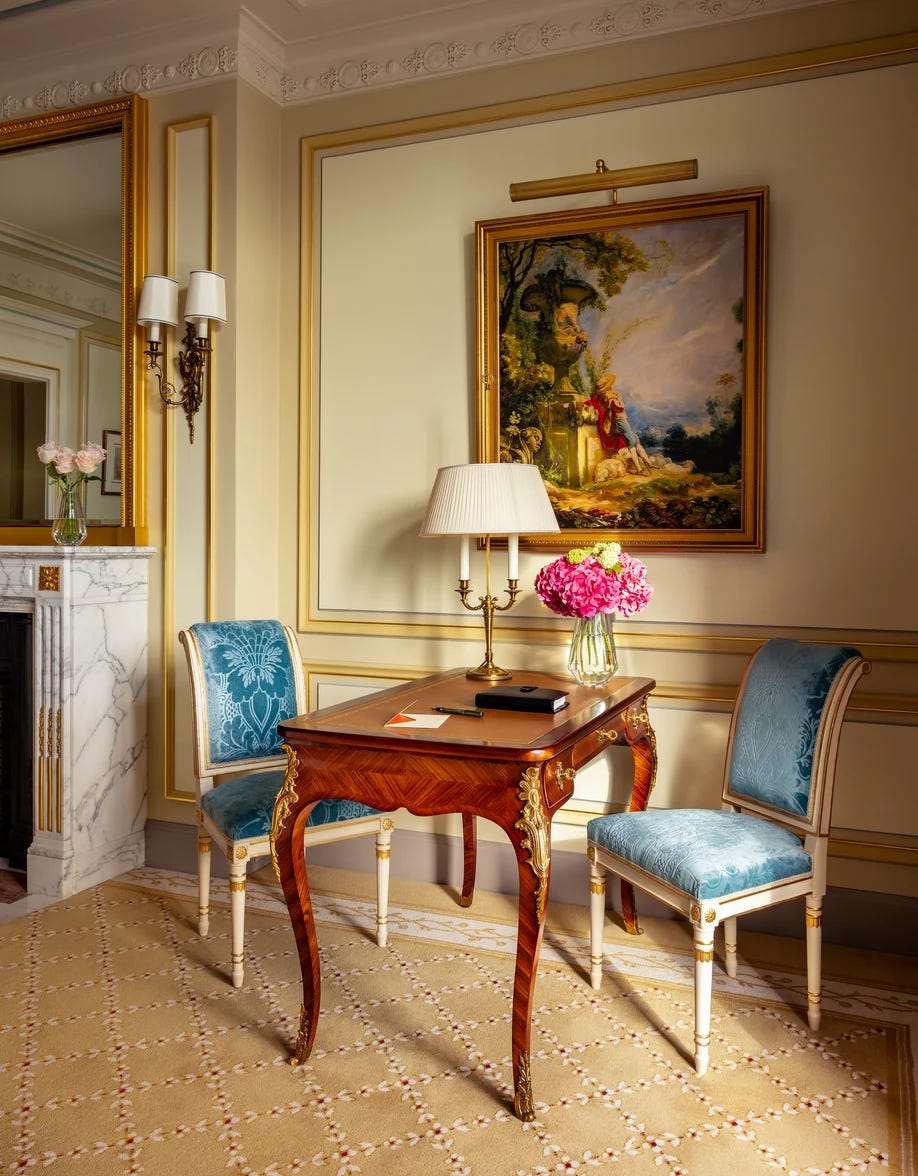
Move away from the city towards remote, high-end retreats, and the desk disappears again—this time because it’s an unwelcome reminder of work, and the wealthiest guests are increasingly gravitating towards insulated, residential-style villas over more traditional hotel layouts.
According to Deloitte, 68 per cent of luxury travel advisers report that clients are opting for longer stays, more privacy, and premium, high-end amenities. In practice, I’m taking that as home-like. Travellers might still be working during their stay, but they do so from a mahogany dining table or a hand-carved library bureau. The corporate aesthetic is completely bleached out of the environment, ensuring the visual cues of a holiday remain undisturbed.
In my opinion, the disappearing act highlights a spatial trap. The old and heavy desk was a strict boundary marker. When you closed your laptop and stepped away from that wooden perimeter, your work was over. Or on pause. But this modern phenomenon of work-from-anywhere fluidity has taken away that crucial architecture of isolation. Without a dedicated anchor, work has bled into every aspect of our stay, and I care deeply about the separation. You, however, might not. And that’s fine because I don’t believe hotels can win either way.

INDUSTRY
We were all waiting for it, but Ian Schrager has pushed the opening of PUBLIC West Hollywood to September, having originally targeted July. I will say, there’s a slight internal tension in the press release. Pawson is the named collaborator, but the copy disavows ‘predictable minimal design’, which is an interesting thing to say about a hotel shaped by the most doctrinaire minimalist in the field. Or maybe I’m interpreting it wrongly.
Design Hotels has signed its largest portfolio addition: 16 Palisociety hotels across nine US destinations. Named properties joining include Palihouse West Hollywood, Le Petit Pali Laguna Beach, ARRIVE Albuquerque and The Hôtel Lili Beverly Hills, with the full set migrating over the coming months.
Design Hotels is a 300+ property soft brand owned by Marriott, and Palisociety is Avi Brosh’s LA-founded group, consisting of 20+ hotels, residences and restaurants across five sub-brands.
Both sides talk of founders, independence, ‘connection to place’, a ‘natural evolution’. Stijn Oyen frames it as kinship between original thinkers; Brosh frames it as a shared love of design and culture.
This is an independent group trading a degree of autonomy for Marriott’s reservation pipeline and reach, and everyone agrees to call it a meeting of independent minds rather than what it actually is…
The Stockman, an Auberge Collection property, will open in 2030 at Steamboat Resort in Colorado. It’s a nine-storey slope-side development with 59 hotel rooms and 95 ski-in and ski-out residences, developed by Stockman Development LLC under Marquee Development.
OZ Architecture handles the building and Nunzio Marc DeSantis Architects handles the interiors. Natural materials, clean lines, locally sourced stone, wood, steel and glass, with solar and geothermal-ready systems on the spec sheet.
MIND
The whole texting to schedule a call thing has honestly turned casual friendships into some weird form of middle management, where instead of just hearing a friend’s voice, you’re stuck trading available time blocks. Somehow, an unannounced phone call is aggressive, reserved for emergencies, so we send these polite little hostage-negotiation texts like ‘hey! Free to chat sometime this week?’ which inevitably never happens. It’s especially annoying with long-distance friends because the phone is the only bridge left. So when that bridge requires 2-3 business days to sort out, it begins to feel like a chore. We do it because we’re afraid of being a burden. I get it. But staring at a text thread trying to align two chaotic adult lives is worse than just dialling the number, catching them for four minutes while they’re folding laundry, or just leaving a voice note and letting the phone-tag Gods take the wheel.

Thank you for reading and supporting The Other HAFH. I’ll catch you next week for another essay.
I alwaysss need a desk in the room, it’s just expected! Feels weird when there isn’t that foundation
Ok once again, so many thoughts:
firstly, I can't stand it when there's no proper desk - you want me to journal lying on my stomach on the bed? No sir I need to go full franciscan monk with it. Secondly, I'm drooling at the thought of the Stockman. I love ski-in done well. Lastly, bring back spontaneously calling your friends, couldn't agree more