

Another day, another Ray Oldenburg reference. In his seminal work, The Great Good Place, he notes that the health of any democratic society depends on its third places. These are fundamentally different from the home (first place) and the workplace (second place).
Real third places are things like the classic Parisian café or an English pub, which are typically defined by their low barriers to entry and the natural levelling effect they have on social status. To put it more poignantly: they’re the crucibles of organic community, where anyone and everyone can partake.
But as you enter the upper echelons of global hospitality, these democratic ideals start to slip away. The third place ceases to be a level playing field and starts becoming an engine of social sorting.
In today’s newsletter, I want to explore the contradictions of these elite hangouts. The critique I hear is that they’re a failure of taste, with artistic imagination being replaced by corporate brand execution. But failure assumes wrong. To someone who finds the room comforting and timeless, nothing has failed. So the more telling question isn’t whether these spaces are nicely designed. It’s what the design is for.
In any case, I’ll argue that they can’t be called third places. At least, not in the traditional sense.

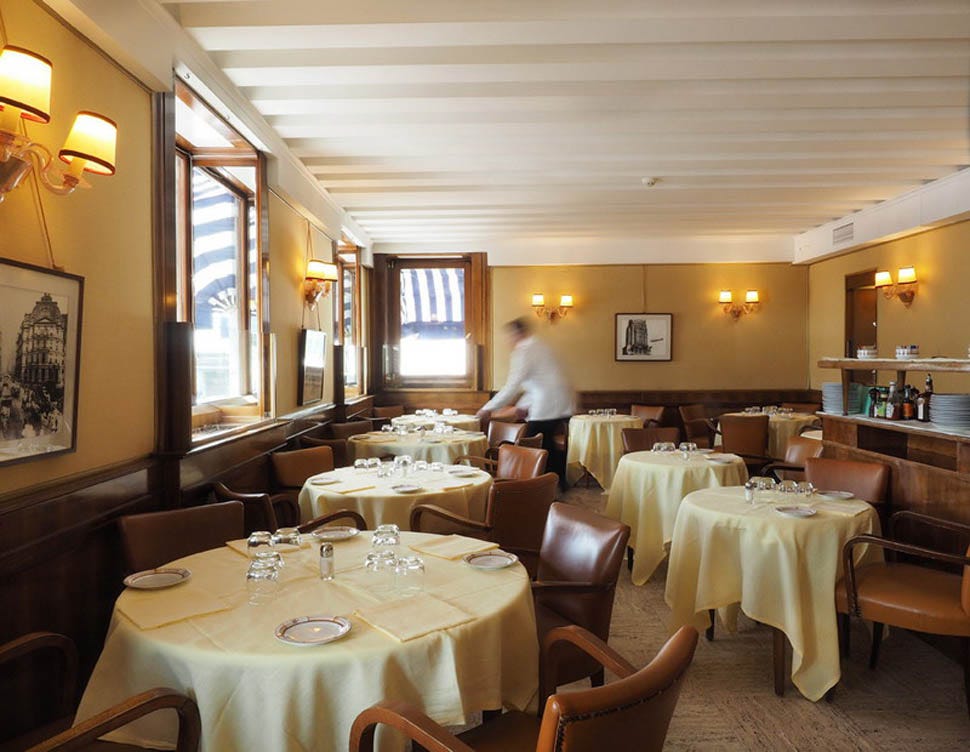
Cipriani is a good example. Wherever you go, whether that’s New York or Dubai, the sensory impression is the same. The walls are wrapped in heavily lacquered Canaletto walnut or mahogany, punctuated by gleaming chrome and polished brass hardware. The rooms look like nothing so much as the cabin of a vintage Riva speedboat, which, arguably, is the ultimate accessory of a mid-century European baron who likes to lounge on Lake Como or the Amalfi Coast.
To its credit, the nautical theme works well. It creates an air of elite leisure in an otherwise chaotic urban centre. The finishes are of high quality, yes, but let’s not pretend they’re chosen for their ingenuity—they’re chosen to tap into a collective, gently snobbish nostalgia for summering far from the plebeian hordes.
What I do find slick is how these spaces can manipulate human posture to control the vibe.
One of the most famous design choices of Giuseppe Cipriani, the founder of the original Harry’s Bar in Venice, was the intentional shortening of restaurant furniture.
Standard restaurant dining tables are 29 to 30 inches high, with proportional chairs. Cipriani tables and chairs, however, are lowered by a few inches, which completely changes the ergonomics of dining.
When a guest is seated in a low-slung chair, they’re almost forced to recline. Their centre of gravity tilts backwards, their posture relaxes, and their gaze is cast slightly upwards. Gone is the upright starch of a boardroom or a conventional Michelin-starred restaurant. The space now feels effortless, nonchalant even—what the Italians call ‘sprezzatura’. So even if the room is packed with stressed-out execs, the chair forces them to look like relaxed, under-employed European gentry.
Neat, right? Because no matter how frenetic reality becomes, the wealthy will pay handsomely for spaces that promise absolute stasis. It’s ironic; they’re buying a pause from the turmoil they help create by day, and the heavy walnut panelling becomes a shield against the frightening speed of the 21st century.
But no, this isn’t an ‘eat the rich’ essay.
Today’s money—old, nouveau, crypto—is all happily jumbled, but the anxieties that shape their third places are anything but uniform.
Broadly, I’d say the design pivots between two illusions:
The nostalgic
The domestic
The nostalgic sanctuary relies on legacy luxury models. Environments like Cipriani are a pleasant fiction of historical permanence. And by including heritage design elements, the guest is swaddled in a shared, romanticised past in which class hierarchies were undisputed, and the world advanced at a much slower pace.
The domestic sanctuary, on the other hand, caters to the fear of being seen. Places like San Vicente Bungalows in West Hollywood, for example, swerve away from the resort template in favour of an artfully dishevelled, residential bohemia. The goal is to camouflage wealth and power behind soft furnishings of egalitarian values, so the multi-million dollar venue comes off as the cosy, book-lined den of your most cultured, intellectually intimidating friend.
But underneath the loosey-goosey casualness and fleece-vest-friendly exterior hides a more nuanced form of control, because to keep the illusion of intimacy unspoilt, the operational tactics are, if anything, more exacting than those of its nostalgic counterpart.
On arrival at San Vicente Bungalows, staff place stickers over the cameras of every guest’s phone. Photography and social media posting are strictly not permitted under penalty of banishment.
Side note: you can hire the space out for private events.
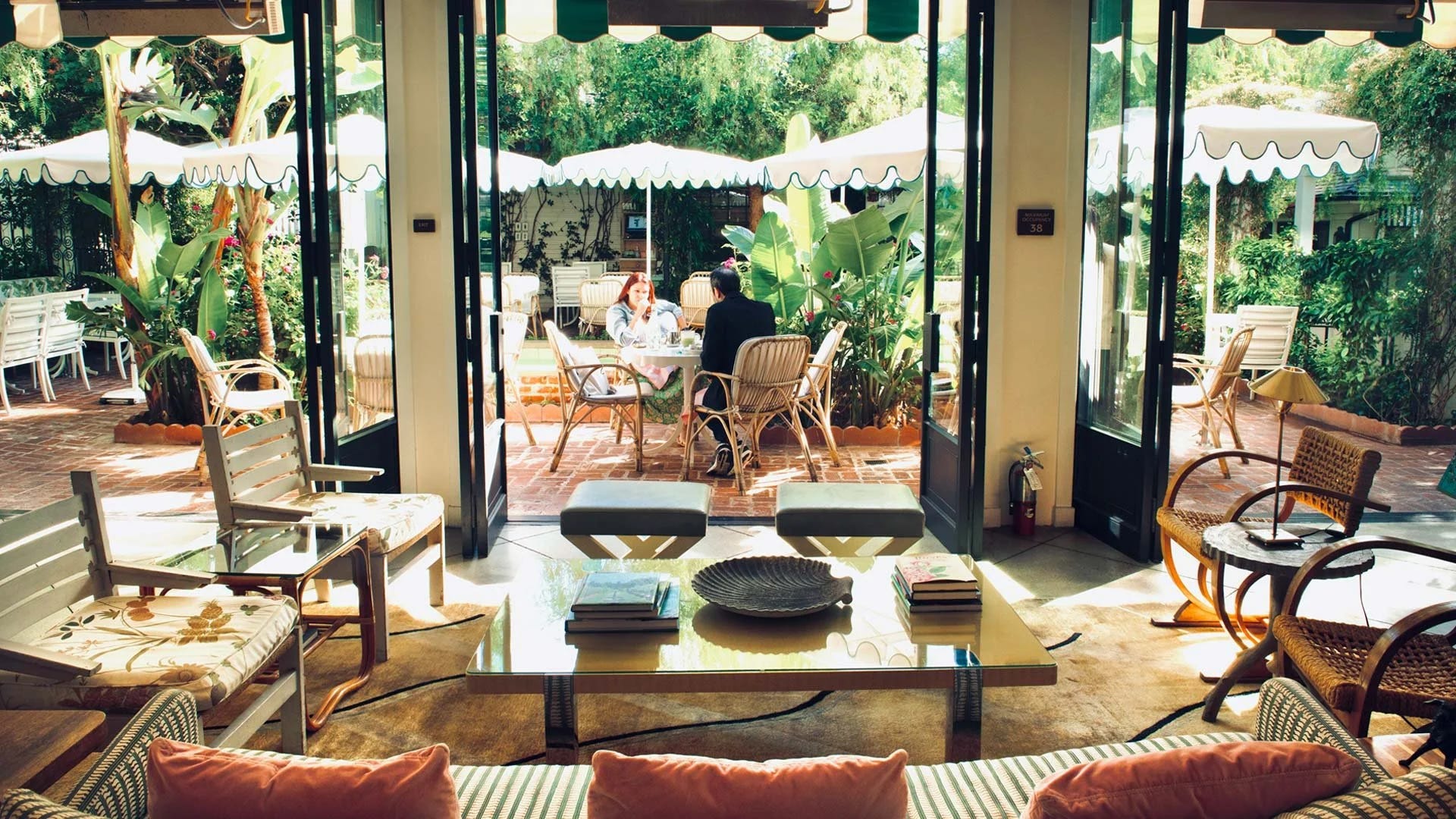
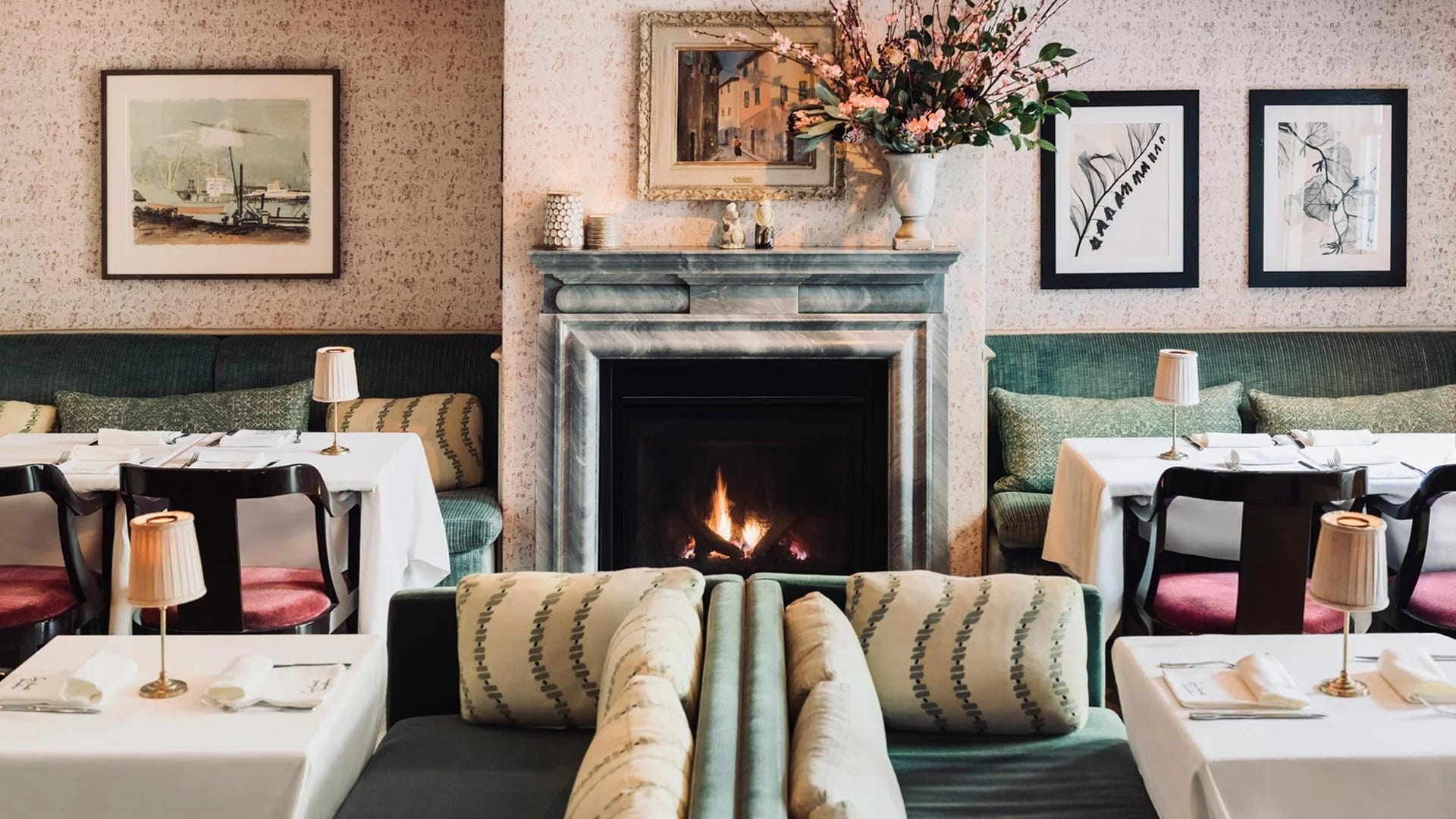
While a nostalgic sanctuary relies on the instant legibility of its physical brand to project exclusivity, the domestic sanctuary uses more casual design, masked by strict rules, to swap a loud display of wealth for a quieter display of highbrow community.
What these two illusions have in common, however, is that both are simulations of private life. The nostalgic borrows somebody else’s past (the yacht, an inherited world). The domestic borrows a friend’s present. Either way, the design’s job is to make you feel like an invited guest instead of a customer in a commercial venue. That, I’d argue, is the overarching trend. Membership prepaid, staff who behave like household staff, camera stickers, low chairs—it all erases evidence that this is commerce.
And yet, despite all the effort to disguise the commercial side, the social side, i.e. the profiling, is extremely calculated.
Would I go so far as to call these spaces boring? I don’t know. To call them ‘boring’ is no different to calling a poker chip boring. They’re not trying to be anything other than a token of entry.
I suppose I do fear that when you sanitise a space of all social risk, you inevitably sanitise it of all life. The atmosphere becomes so tightly controlled that it stops feeling like a living, breathing neighbourhood hangout.
Historically, the most vital third places emerged from economic tensions and cultural clashes, spawning subcultures almost by accident. The modern elite crave that authenticity, but the moment a hospitality group tries to bottle, brand and peddle that energy to a more-or-less homogeneous crowd, any chance of spontaneity dies.
So far, my critique has run solely through the populist lens of Oldenburg’s democratic public house, which I realise is a category error. Calling them third places at all is a misnomer.
If Oldenburg’s third place is defined by a low barrier to entry and a natural levelling effect, these elite spaces are something else. Call them fourth places. It’s a phrase that’s been drifting around urbanism circles for years without a settled meaning, so I’m claiming it for this: spaces that look and feel like social third places, but are intentionally privatised and segregated.
To their fiercely loyal patrons, fourth places aren’t sterile vacuums. They’re necessary redoubts for a tightly managed world. After all, for many public figures, relaxation is simply not on offer in the wilds of the common sphere.
A sorting hat, therefore, is a design requirement, not an act of arbitrary exclusion. Within the safety of a filtered crowd, homogeneity becomes a psychological luxury, and patrons can lower their guard. The exclusivity allows for intimacy.
To take this argument to its ultimate realisation is to accept that the uniformity of these brands is essential. Their clientele doesn’t want surprises; they want the familiar—the predictable.
This applies to both illusions. San Vicente Bungalows is now located in West Hollywood, Santa Monica and the West Village, having converted the old Jane Hotel with the aid of Rose Uniacke’s interiors. Members can opt into a global tier membership to gain cross-property access.
I will say, however, that as predictability becomes the metric for success, the bar for artistry is lowered. Architecture is no longer tasked with being experimental; it’s tasked with reassuring. That’s the trade-off in luxury hospitality design: you gain sanctuary and continuity, but you sacrifice some magic.

INDUSTRY
The LINE Austin went to foreclosure auction last week. JP Morgan held the $172m note, bid exactly $172m, and won unopposed. Eight months earlier, Condé Nast Traveler had named it one of the best hotels in Texas. I would agree, at least as far as Austin goes. Sadly, DC went a similar way in 2025, and LA soon after.
Also in Austin, The Driskill has completed a full renovation ahead of its 140th anniversary this December (it opened in 1886 as Texas’s first luxury hotel). On the design side, the room and suite count goes from 175 to 189. Dallas-based SWOON, the studio handled the guest rooms; Lambert McGuire Design did the lobby and restaurant spaces; and Clayton Korte was the architect of record. The headline addition is the 2,800 square-foot Citadel Ballroom, formerly a private club, now an event space for up to 200, done in warm yellow and gold.
MIND
I was on the phone with a close friend a few days ago, and my heart ached for her. She said she felt nothing but pure, unadulterated frustration lately, and for no particular reason. I knew the headspace immediately. When you reach that point, your nervous system is so fried that your baseline tolerance hits zero, and the people closest to you end up taking the hit.
We could, of course, dismiss it as hormones or blame it on the week’s relentless grind. But sometimes it’s less immediate and more existential.
It’s made me consider the invisible burdens we all drag behind us—those unseen rucksacks filled with silent grievances. Most of the time, the anger isn’t really about its supposed targets. It’s the body’s cry for respite. But what does a pause actually resemble when the world only accelerates? My dad, ever the pragmatist, insists it’s about relinquishing the outcome. Care less, but that doesn’t mean becoming cold or indifferent. So many fine lines to keep track of.
THINGS
Love Island is back (yes, I watch it, and I resent any judgement. And if you must know, I’m partial to the UK one). In honour of it, I found this video by Reeves Connelly, which I thought was an interesting breakdown of the set design:
I’ve graduated from BIC. MUJI was founded as a protest against branded consumerism. And my God, the retractable gel pens get everything right. The ink glides onto the page without scratching or skipping, and the best part is that it dries straightaway.

Thank you for reading and supporting The Other HAFH. I’ll catch you next Friday.
Real community can't be curated by status. This shift toward "the fourth place" is where hospitality finds its soul again.
I’ve been thinking a lot about this and it’s so satisfying that you put the words on it!!