

I’m in my 30s, and there’s a certain type of woman of a similar age that I’ve been observing at upscale coffee shops. I say that in the least sinister way possible. She’s wearing Lululemon or Alo or something adjacent. Branded, expensive. But she’s not going to the gym. She’s going to brunch or a farmers market, or back to the house. She’s dressed to denote how little she cares about what she’s dressed in, but the effort is immense. It’s the opposite of effortless.
I have plenty of opinions about this. So does David, apparently, as he’s the one who brought it up this time. What Americans appear to reach for, he said, is the European ease. The unthinking quality of someone who’s never had to construct an identity around their taste because taste was ambient. The aim is to seem like someone who doesn't think about seeming.
Wouldn’t that be nice?
Beyond fashion, we see the same thing in hospitality design, where a foreign fantasy is being pushed and sold. That’s what I want to touch upon this week.

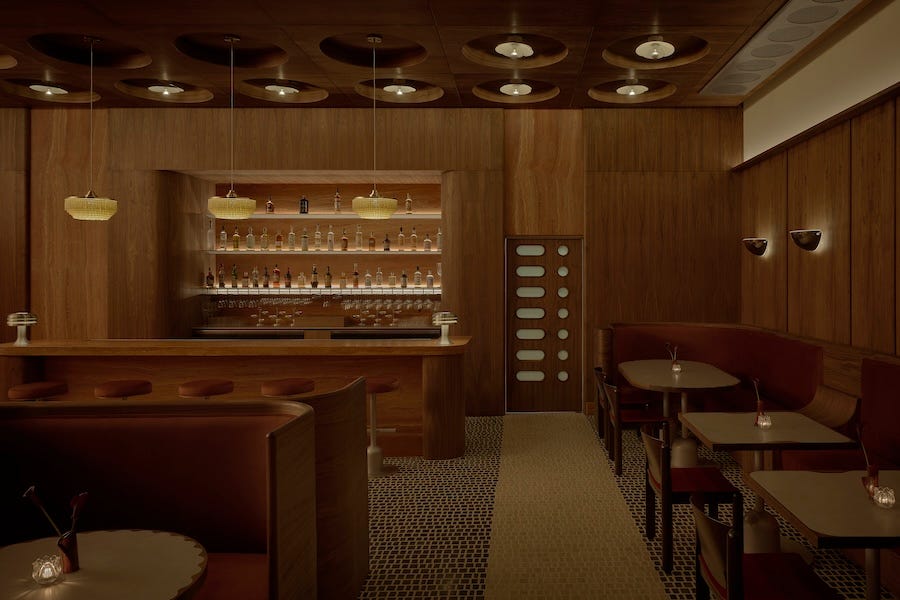
LA’s getting yet another eatery. I saw a press release about Bar di Bello, which is opening this spring in Silver Lake, designed by 22RE.
It’s inspired by European cafés, and there’s no soft-pedalling about that. The design studio knew exactly what they were trying to achieve, and they did so with some rigour.
Ignoring the dining part for a moment, it’s honestly quite endearing how Americans romanticise European café culture. The longing is all too familiar by now, especially after you’ve been to Italy, France or Portugal. You get to sit somewhere for several hours without once feeling like you have to justify your being there. Nobody calculates the margin on a single flat white against the table you’ve occupied, so you can order just one thing, as you stay for as long as you want and leave whenever you want.
You come back home and you try to replicate it. You go to your local coffee shop and open up your laptop out of pure reflex. The room’s got USB ports and fast, free WiFi, but it also comes with a turnover policy that’s hard to ignore. And then you feel bad if you’ve taken up too much time. After all, you’re trying to support small businesses, not hinder them from making a profit in these trying times.
I’ve previously written about our obsession with slow travel, and how the idea of an unhurried life gets fetishised even though the commitment to being extremely busy stays intact. The logic of the WeWork era reached coffee culture, with laptop-friendly tables and longer opening hours. But European cafés don’t work the same way.
So how did Americans get here?
In 1983, Howard Schultz walked into an espresso bar in Milan and had exactly the same experience most American tourists have been having since. He was struck by the ritual of it all. The speed and the warmth and the social ease of the room. He came home and rebuilt Starbucks, naming the European café as his model.
What he actually built was a production line with decent-ish sofas. I’m not trying to be hard on the man. He understood his market. America didn’t want the Milanese bar. It wanted a branded, climate-controlled, reliably identical version of a Milanese bar, available at scale, in every suburb and airport terminal on the continent. Schultz’s third place became the most monetised public room in history.
The third wave coffee movement spent the following decade pushing back with better beans and independent ownership. I personally love Blue Bottle and Intelligentsia. They might have slower service, but they’ve at least got high standards. The Starbucks model was rejected out of principle. But the laptops followed anyway.
The indie café became the default office annex for the freelance class and the remote worker who needed somewhere to be that wasn’t their home. Café owners started installing uncomfortable chairs to discourage long stays, at least, I like to think so, and they charged for WiFi, then removed it altogether. Some printed passive aggressive signs about laptop-free tables, then laptop-free hours. The room kept trying to resist the use it was being put to.
The pandemic essentially finished the job. Offices closed and cafés became primary workspaces for months, then years. By the time restrictions lifted, the habit was set.
Now, we’re back to a design brief. The standing espresso bar, with no WiFi and counter service only, has been appearing in cities like New York, Chicago and LA for the last eighteen months.
The Italian bar, for reference, is not the same object as any of this.
A coffee, drunk standing at a zinc counter, takes four minutes and costs much less. The design of the room allows for this. The counter is often positioned so you have somewhere to place your cup and someone to talk to if you want. The bar is set up as a place you pass through, not a place you park. You’re meant to use it the same way you’d use a pavement. Briefly and in motion.
This works because no one inside it, including you, is expected to be productive. The transaction is finished the moment you drink your coffee. And that permission is cultural.
22RE did their homework. At Bar di Bello, the kitchen pass beside the bar, the central walnut banquette that bisects the room without blocking flow, is trying to replicate how Italian dining rooms move, not just how they look.
I’m sure it’ll be filled each morning with people who know exactly what the red travertine is supposed to signal. They’ll sit in the Magistretti chairs and feel, briefly, like they’re somewhere in northern Italy. Some of them will stay for hours. Most of them will have their phones out by the time the coffee arrives. Not photographing, per se, but they’re one notification away from being a productive professional again.
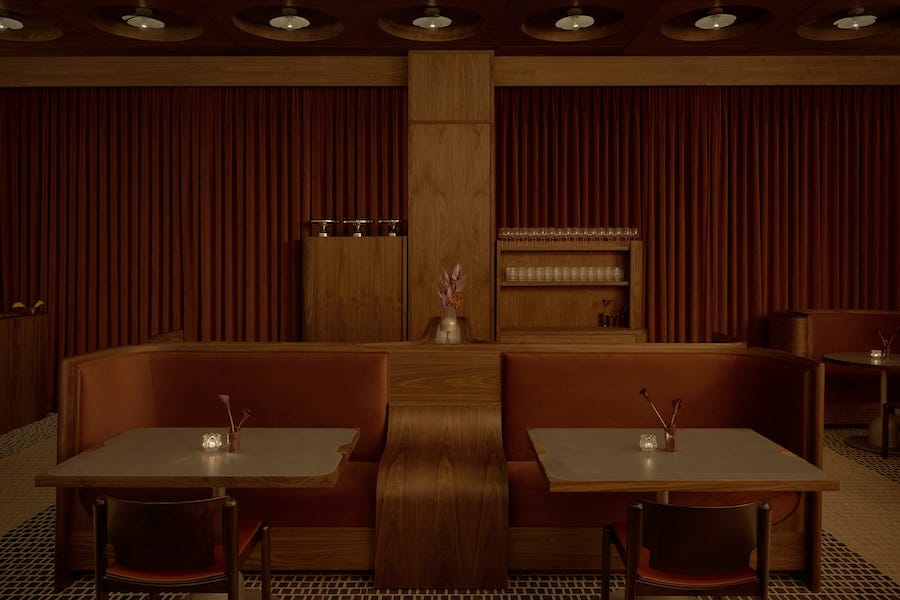
Silver Lake is absolutely the right neighbourhood for this contradiction. It’s a part of LA that’s been performing its own idea of European living for some years now. Its residents are among the most committed practitioners of the unhurried lifestyle, and they have the means to remain this way.
The design-literate professional class has acquired an extremely refined capacity to adopt the visual cues of slowness. For example, linen trousers that suggest you don’t work a 9 to 5 and the unscheduled Saturday morning that is, in fact, scheduled. There’s also the holidays to Puglia that produce 40 photos of a table in the shade and a glass of something local. That’s slowness.
The appetite for European café culture in America isn’t really an appetite for slowness. It’s an appetite for the idea of slowness. In other words, the idea of an individual who can sit in a beautiful room on a random Tuesday afternoon, free from guilt.
The design industry has built around that idea accordingly. And Bar di Bello is an honest expression. The Italian references aren’t just decorative; the spatial flow is actually really good here.
What we don’t know, however, is whether such cultural imports will hold.
Does the sincerity of the design compensate for the insincerity of the impulse?
Am I looking into this a little too deeply?
Yes.
Good design creates conditions for the thing it’s supposedly only imitating. If you sit in the right chair with the right cup, the permission you couldn’t bring yourself to take sometimes just materialises. Not the European permission. Not exactly. But something more contingent.
In other words, Americans need a designed and tested environment to give themselves permission to do what Europeans just do. Schultz tried to solve it with scale. The third wave tried to solve it with quality. The standing espresso bar is trying to solve it with inconvenience. And places like Bar di Bello are trying to solve it with faithful hospitality design.
These coffee shops and bars won’t transform this country’s relationship to productivity. Americans work too hard, and the kitchen pass won’t exactly stop anyone from checking their inbox. But the room has enough character. It’s not a pastiche, and I’m here for that.

WELLNESS
Got a heads up about this brand from Michaela Carpenter: VOSK Center in NYC. One browse through the website, and you can see how slick they are. But what’s stuck with me is what Michaela said about hospitality going beyond hotels. To be honest, the core principles of hospitality can apply to anything, really. It’s about looking after someone or something the same way you’d want to be looked after yourself. To be hospitable is to be a very good person. And there’s nothing I want more for us than to lean a little harder into that philosophy—more so now than ever.
THINGS
A friend recently gifted me a wax seal stamp with my initial on it. It was such a beautiful gift idea, especially since I’m a stationery nut, and it’s one that I’ll use forevermore. Who knows, I might even turn the design into a signet ring in the future. Anyway, this is a gift idea for you to steal and delight a loved one in your life. It’ll go down a treat for the analogue proponents among us.
Speaking of gifts, it was David’s birthday over the weekend, and I decided to gift him a Japanese knife. We’ve decided to view kitchenware with the utmost seriousness in this household, and there’s something stunning about a long, sharp knife that’ll develop a nice patina over time. Through research, I’ve learnt that it’s better to have a handful of knives than to buy a full set. But perfect knives are hard to come by in the West, at least, when you’re looking at small batch Japanese craftsmanship. Shoutout to Tosho Knife Arts, a Toronto-based company that makes finding and buying these knives a little bit easier. Be warned, though, most of the featured items are sold out. The pains of building a covetable collection.
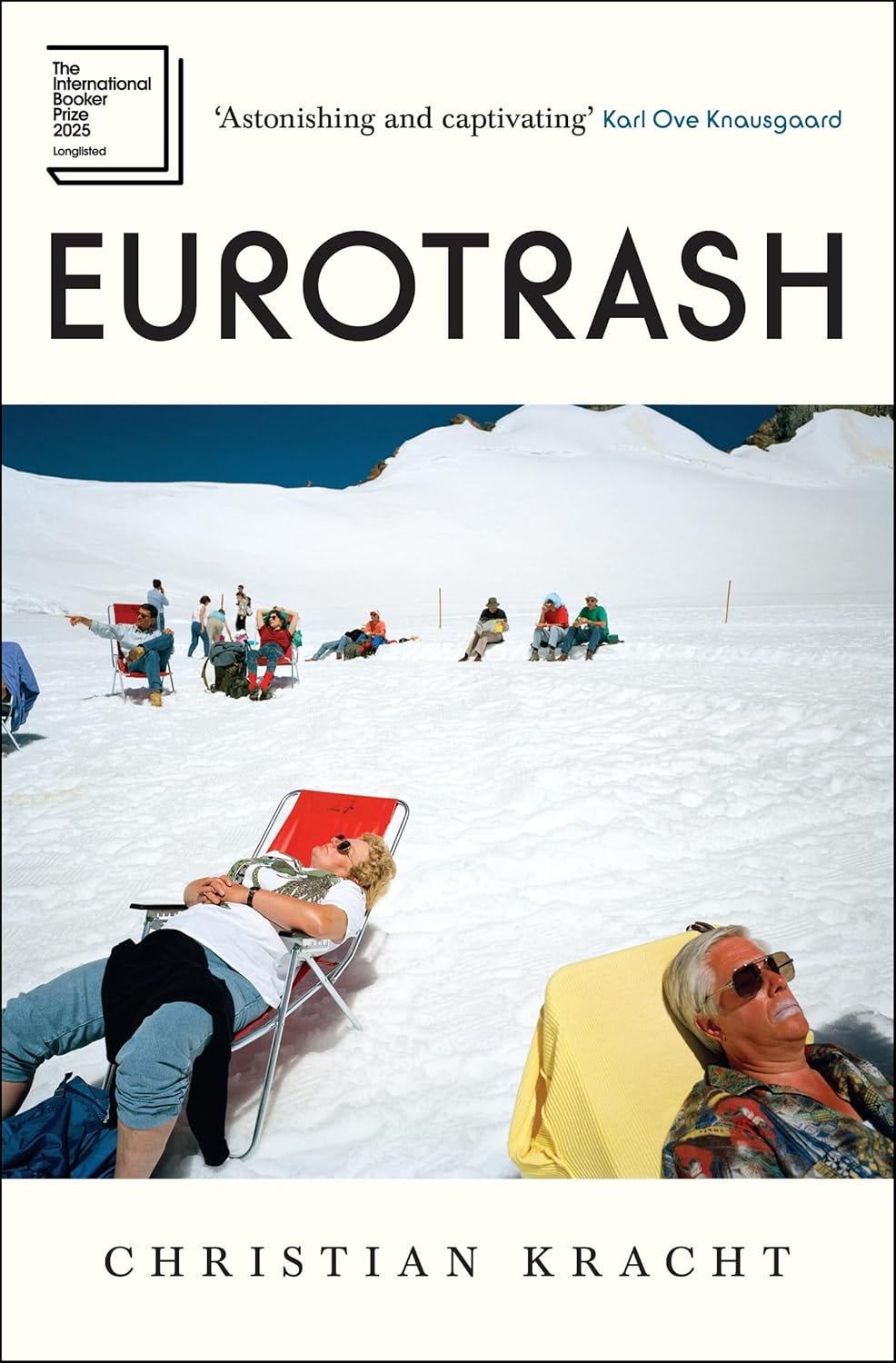
It’s been so long since I’ve read a book that actually made me chuckle out loud. Eurotrash by Swiss author Christian Kracht has brought that joy back into my life. It follows a son escorting his estranged mother through Switzerland to rid her of a fortune made dirty by the armaments industry. Dark comedy, and highly recommended for those of you who live for that type of humour.
Lastly, does everyone’s Pinterest look identical now? I love marble and chevron parquet as much as the next person, but it appears as if every kitchen renovation is pulling from the same reference point. I’m turned off. Individual taste is collapsing.

Thank you for reading and supporting The Other HAFH. If you liked this post, consider forwarding it to someone else who might like it, too. I’ll catch you next week.
Girl I have so many thoughts on this I feel like I should respond in essay-form!!! Anyways this is my favorite Friday night read every week without a fail