

I hope your allergies are treating you well this spring. I never thought I’d be one for sniffling and sneezing this time of the year. I’ve always been smugly immune. That annoying person who said it doesn’t affect me while others reached for antihistamines. My body has decided to correct this. The weather’s gorgeous albeit vengeful.
That’s just one minor, minor thing that pisses me off. The world, as a whole, is heavy. I find myself feeling less and less motivated to post anything given the state of humanity. There are so many moral and philosophical questions at play, namely about what we owe each other, who gets to be safe and who doesn’t, whether the ordinary business of living can be conducted in good conscience while catastrophe plays out somewhere else on the planet, in real time, on the same phone I use to check the weather.
I don’t have a clean answer to those questions. I’m not sure anyone does. What I do know is that I’ve been sitting with the same guilt that I suspect many of you are feeling, too. The guilt of continuing. Of writing about hotels and aesthetics while other people are losing everything. It makes the work feel thin. So very thin. I’ve started sentences I couldn’t finish because they seemed, in the moment, beside the point.
However, I keep coming back to a quote I read on Pinterest of all places:
Beauty is not a retreat from the world, it is an argument about what the world should be.
I don’t know if I fully believe this. But I find myself wanting to. You have to pay attention to notice a well-made thing, whether that’s a room, a meal, a piece of fabric or light. On good days, that seems like an act of resistance against the forces that would otherwise make everything coarser, louder, cruder. On bad days, it seems like nothing at all.
I wrote this post on a bad-ish day, if I’m being honest. I just hope you know that these newsletters are written with full awareness that the stakes of what I cover are so shockingly modest compared to what’s happening elsewhere, and with an imperfect belief that modest stakes are still worth caring about.

I’ve been looking at photos of the new Six Senses in London, and the first thing that always catches my eye is the shower. It’s standing there in the middle of the room, not exactly in the bathroom, framed in what looks like black steel, vaulted like a Victorian reliquary.
Reader, there was no door.
The open-plan bathroom is one of the hotel industry’s more successful acts of design revisionism. It’s a cost-cutting measure, fundamentally, with wellness language slapped onto it to make it seem intentional. And while wellness brands can migrate from the tropics to the city, the design logic can’t always travel with them.
You see, Whiteleys, the old building where the new Six Senses is housed, comes with a very specific history. William Whiteley opened his first drapery on Westbourne Grove in 1863 and within a decade had expanded into what became widely considered London’s first department store, claiming he could supply anything from a pin to an elephant.
The building that survives on Queensway dates to the Edwardian period, featuring a domed pavilion, symmetrical wings and sculpted pediments. Foster + Partners have reimagined the shell. AvroKO, the New York-based studio, has done the interiors, integrating Art Deco and post-Victorian references with the brand’s signature botanical style.
The £1.5 billion development also contains 139 branded residences, an Everyman Cinema and a Third Space gym. In other words, it’s working really hard to be seen as contemporary luxury in a bustling city like London.
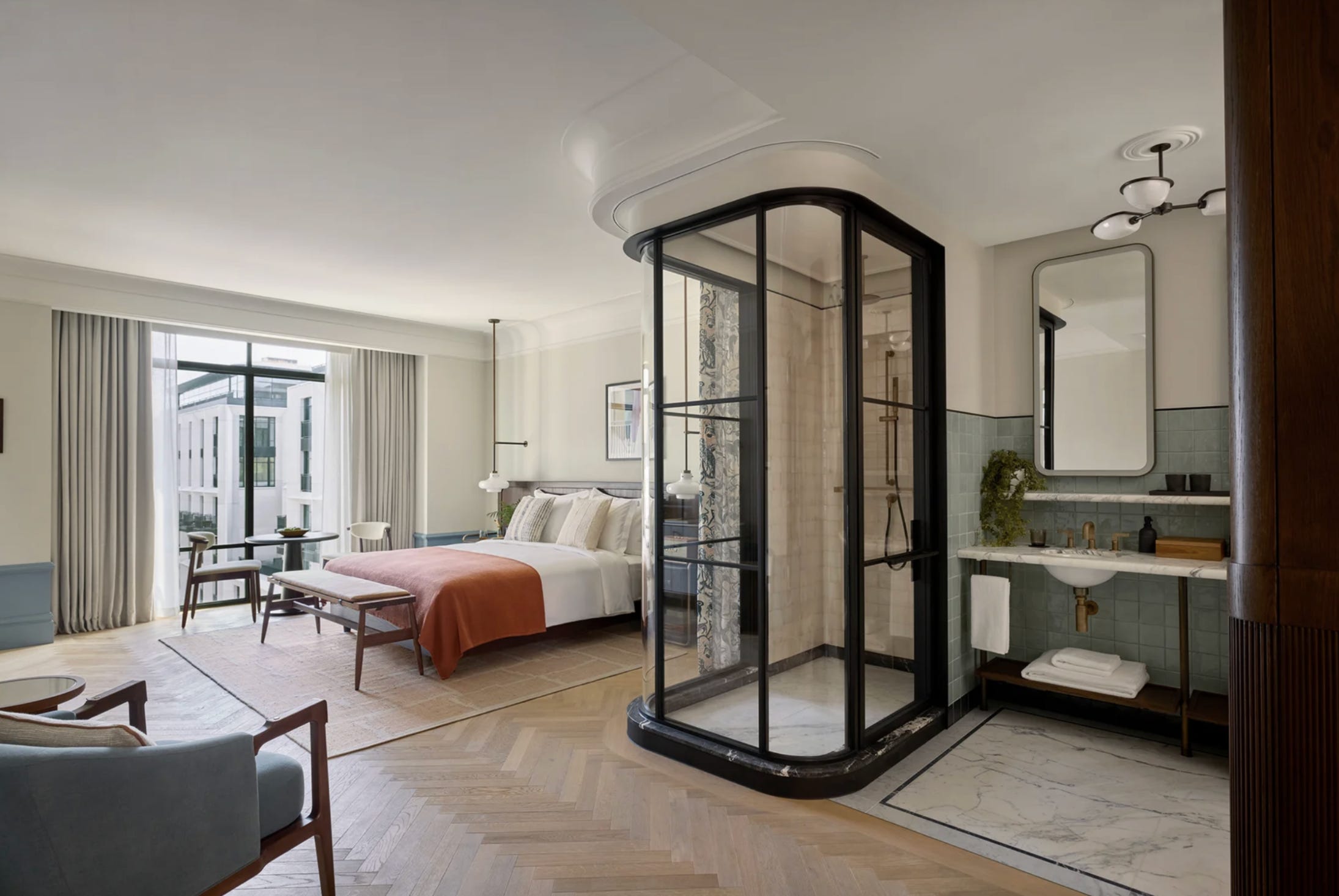
In a Six Senses in the Maldives or Koh Samui, the southeast Asian resorts where the brand first planted its flag, the open bathroom makes unimpeachable sense. The resort model is premised on the dissolution of interior and exterior, so the bathing pavilion as a form of outdoor living isn’t an aesthetic choice so much as a climatic one. The body is exposed to warm air and the sounds of the surrounding landscape seep through the architecture. It sounds lovely. In Bayswater, however, with the rain doing what it does and the Queensway fast-food strip still doing what it does, the effect is quite different.
I suppose the need to wedge this trend into some coherent design tradition is understandable. The instinct is to reach backwards for legitimacy, and the Victorian precedent is superficially compelling.
For much of Britain’s domestic history, the bathroom didn’t exist as a dedicated room. Until the mid-to-late nineteenth century, even in wealthy households, the bathtub was a portable affair, copper or tin, brought into the bedroom or, in more modest circumstances, placed in front of the kitchen range. The wash stand was a piece of bedroom furniture, possibly marble-topped, with a porcelain bowl and jug serving as basin and tap for those without indoor plumbing. In grander houses with early piped water, wash basins were installed in bedchambers; the dedicated bathroom, when it arrived at all, arrived separately from the water closet, which was a different room again. The consolidation of tub, sink and toilet into a single enclosed space was a late-Victorian and Edwardian phenomenon, driven by the convergence of city sewers, central heating and pressurised hot water pipes.
This is the history the hotel world, at least in England, likes to invoke. Selectively, of course.
The bathtub in the bedroom sounds romantic. And a room dedicated to bathing was unusual in Britain until after the First World War, and what preceded it wasn’t necessarily a design sensibility. It was poverty and the absence of anything better. The creation of the enclosed bathroom was a feat of civic engineering and social aspiration combined. The middle classes clamoured for bodily privacy, which sanitation reform had made newly possible. Chamber pots were emptied by servants several times a day. And the shared tin bath in front of the kitchen range was filled in strict order of household hierarchy (babies going last) into water that by that point had become a problem in its own right.
To reverse-engineer those conditions as an aesthetic is a peculiarly retrograde form of luxury signalling.
The trend has been building for several decades. Paula O’Callaghan, a partner at the global hospitality design firm HBA, traced it to the original Park Hyatt Tokyo, which opened in 1994 with frosted glass partitions. There were panels dividing shower from toilet and frosted glass on the door. By the standards of the moment, it was arrestingly avant-garde. The design world was gushing.
The Standard Hotels, under André Balazs from 1999 onwards, pushed the possibility further, with bathrooms visible from the room, the street and other angles that might be considered scandalous. By the early 2010s, the open bathroom had become almost a baseline expectation of a certain class of city hotel, especially as Instagram began reshaping how properties understood their own purpose. A free-standing tub in the middle of a room photographs quite well. A closed door not so much.
The real motives aren’t hard to identify, and the hospitality industry isn’t particularly interested in concealing them. The hotel guest room has been shrinking steadily in overall footprint as urban land values have risen. Opening the bathroom to the room creates the illusion of size. Plus, they’re cheaper to build and considerably faster to clean at scale. Essentially, it’s cost-cutting with some fluff about proportion and light to make it seem more design-coded.
I suppose my problem with Six Senses specifically is that its brand DNA is explicitly opposed to frivolity.
Born in the eco-resorts of southeast Asia, it’s a brand built on the claim that slowness and environmental coherence are a form of ethics. The spa at Whiteleys runs to 2,300 square metres and includes a hyperbaric oxygen chamber, red-light therapy, cryotherapy, a flotation pod, a magnesium bath and an on-site medical herbalist dispensing bespoke tinctures from a working apothecary bar. A shaman and a crystal healer were consulted during construction, guiding decisions on spatial energetics, including the placement of a circular window at the hotel’s entrance, positioned to release negative energy. Over five hundred test nights were logged before opening to optimise sleep quality. Every element of the project insists on rigorous, non-negotiable intentionality.
Except, apparently, the bathrooms, which are open-plan in most room categories because the rooms, starting from around £750 per night, are not large enough to enclose both sleeping and bathing space without compromising the former. I don’t see these floor plans as something that caters to the relationship between body, water and rest. It’s a square footage problem resolved with reference to a design trend that the brand’s tropical origins make somewhat plausible.
There’s a further irony worth noting. In its first life, the Whiteleys building was one of the great monuments to Victorian commercial appetite. It was a place that promised to supply anything to anyone, absorbing street after street of Bayswater in its determination to be comprehensive. The introduction of a wellness brand, whose founding philosophy is the rejection of excess, into a building whose entire history is an argument for accumulation is already an amusing proposition.
I don’t think I’m a prude, but I much prefer an enclosed bathroom—with a door and a lock. That is, if I’m sharing the room with someone else. If travelling alone, well, who cares.

INDUSTRY
Edition is coming to Dallas. The brand’s first Texas outpost will sit inside Chalk Hill, a mixed-use tower with 214 rooms and 60 residences starting at $1.5 million. Architecture is led by BOKA Powell, landscape architecture is by SWA in collaboration with SCDA and interiors by bonetti/kozerski.
WELLNESS
I’ve been forcing myself to take my camera everywhere. It’s not something I would have predicted about myself a few years ago. I’m just wrapping my head around the technicalities, but I’m learning, slowly, and I’m making mistakes I only notice after the fact. I’ve come to realise that my love for photography is in the looking—the observing. Light, angle, what to include, what to cut. I’ve noticed things that I would have walked past without a second thought. But there’s pleasure in paying attention and the mild embarrassment that comes with getting the shot in public.
THINGS
Currently in the process of furnishing a rental, which is its own commitment problem. Nothing should matter too much. But it does. And Nordic Knots has got me excited. Apparently my husband and I are the last people to find them, and I don’t know why it took us so long to commit. The rugs are so good. Proper anchors for furniture that’s still deciding where it belongs. It’s true what they say—the right floor covering completely changes the room for the better.

Thank you for reading and supporting The Other HAFH. If you enjoyed this post, consider it passing it along to someone else who might like it, too. It really helps get the word out. For those with bank holidays, I hope you enjoy the long weekend!