

I’m a sucker for good hospitality design, and I’m glad last week’s post seemed to resonate with many of you. It brings me joy that there are others who are also leaning towards a more colourful new year. If you haven’t read it, you can catch it here:

The whole thing got me thinking about other areas of luxury hospitality design that I value. I can’t help but feel that in our recent embrace of ‘quiet luxury’, we’ve lost something quite profound. Don’t get me wrong, I appreciate the ethos, and I’ve talked about it ad nauseam. But I equally admire the unapologetic opulence that comes with traditional luxury design.
Which brings me to Grand Hotels. Once social institutions, now disappearing. Some are being converted into luxury condos, while others are struggling to maintain the standards that their architecture requires. If they do survive, they can’t seem to justify what made them grand in the first place.
Consider this week’s newsletter my attempt to understand why. Because the downturn of the Grand Hotel is a sad, sad thing.

When the Waldorf Astoria reopened last year after an eight-year closure, guests returning to the New York landmark discovered that the hotel had been gutted. What was once 1,400 rooms now operated with just 375. The rest had been carved up and sold off as condos.
To understand the weight of what’s been lost, you need to grasp what 1,400 rooms meant. This wasn’t boutique scarcity or cultivated intimacy. This was luxury conceived as abundance, designed to accommodate hundreds of guests simultaneously without any of them feeling the compromise. That kind of vastness required a very specific vision, which is that grandness could be multiplied without being diminished.
The Waldorf’s ‘makeover’ isn’t an isolated case. The Plaza, another touchstone of Grand Hotel culture, met a similar fate. And the Grand Hyatt near Grand Central has proposed shrinking from 1,300 rooms to about 500 when it reopens as 175 Park Avenue. Across Manhattan alone, thousands of hotel rooms have been converted into residences.
This is the dismantling of an entire theory of what luxury ought to be, and what we're building in place of it exposes a major shift in how we signal status and belonging today.
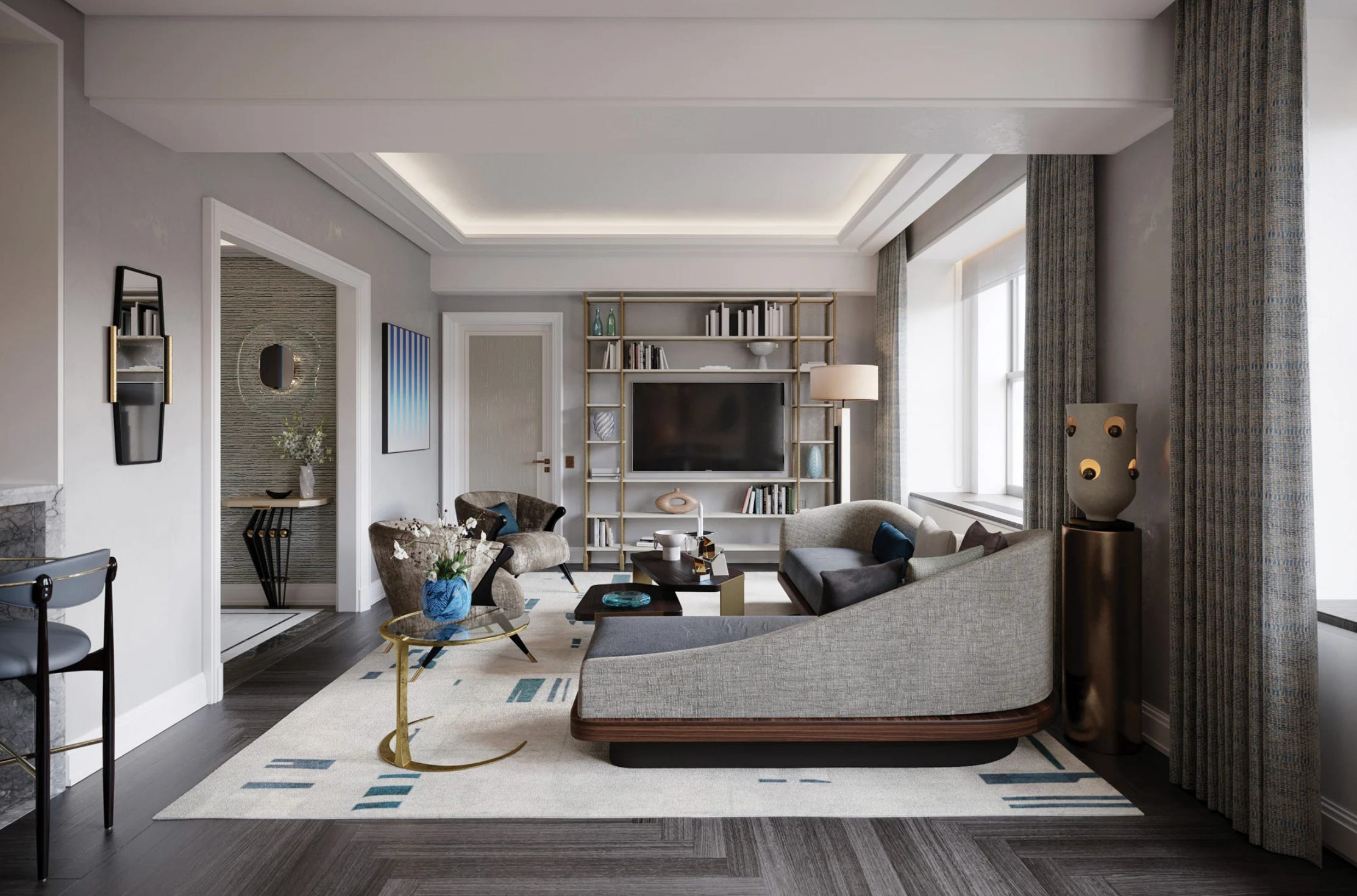
Historically, a Grand Hotel was relentless in its design. Gold fixtures, crystal chandeliers, marble, gilt, soaring ceilings with elaborate plasterwork. Anyone could look at this and recognise it as luxury.
Which is exactly what makes it embarrassing now. In our current luxury landscape, the Grand Hotel reads as gauche. It’s too obvious. Too much. Too nouveau riche. We’ve developed an entire vocabulary of disdain around any type of luxury that doesn’t require ‘decoding’.
What we’re coveting instead works on the opposite principle. ‘Quiet luxury’ reveals itself only to those who already have the cultural capital to recognise it—aesthetics so refined they’re nearly invisible, unless you know what you’re looking at. Or, when we tire of all the restraint, we swing to maximalism with its bold prints and saturated colours. But maximalism only really works if you understand the references and the irony, or the deliberate flouting of good taste.
Both approaches exclude through knowledge as opposed to price alone, i.e. they're codes that reveal themselves exclusively to people who already belong, and that's not incidental to their appeal. The Grand Hotel excluded you if you couldn’t afford the room rate, sure. But this new type of luxury excludes you twice. First if you can’t afford it, and again if you don’t recognise it. It’s a more efficient form of gatekeeping, really.
By contrast, there was something almost democratic in the visibility of Grand Hotels, even if the experience itself remained out of reach. We’ve swapped that transparency for opacity, and in doing so, we’ve also traded monuments for boutiques, since this is about scale, too.
Grand Hotels were monumental, claiming prime corners and avenues. They were frequently built alongside major department stores or central train stations, anchoring a wider civic infrastructure. The expectation here was longevity, and the visionaries placed their bets on architecture that could outlast its creators and remain fixed within the life of the city.
Modern luxury hospitality, however, rejects monumentality. New openings are overwhelmingly boutique hotels, typically 100 to 200 rooms, or they’re branded chains, trading on lifestyle positioning. They're all routinely rebranded every decade or so, interiors refreshed the moment an aesthetic begins to date, chasing whatever happens to be in vogue. Nothing is built anymore with the assumption that it will become a permanent part of urban life. You can say it will, but that isn’t the reality. Everything is designed to be repositioned once tastes change.
Which means, for the most part, the Grand Hotel can no longer compete. I learnt this first-hand when I took my now-husband to The Savoy for afternoon tea four or five years ago. Despite living in London, I’d never been. But I wanted to introduce this American man to the ritual of afternoon tea, and The Savoy, which opened in 1889 as the first British hotel to have electric lights and lifts, felt like an obvious choice.
The setting promised everything it should, but something felt off. Certain areas looked tired. Shabby, even. The gap between what the hotel proposed and what it delivered was more disappointing than if we’d chosen somewhere less ambitious to begin with.
The scale sets such high expectations. When you walk into a space with crystal chandeliers and acres of marble, you expect perfection. So a slightly worn carpet, which might go unnoticed in a smaller hotel, becomes glaring in a space built for show.
The very things that make these hotels so grand are exactly what makes them economically unviable. They require intensive labour and constant investment—costs that make less and less sense when the aesthetic they represent has fallen out of favour.
Of course, one might argue that the aesthetic has fallen out of favour because maintaining it properly is expensive. It’s much easier to declare something vulgar than to admit that you can’t afford to do it well.
Which gets at what this is really about. The traditional Grand Hotel aesthetic hasn’t disappeared entirely. The Ritz (in Paris and London) still operates much as it always has, its gilt undiminished. And The Savoy soldiers on despite its struggles. These institutions endure worldwide, serving clients who still appreciate that vision of luxury. However, we’re not building new ones. When developers and hoteliers invest in luxury hospitality, they’re not choosing to replicate that model.
We, as a society, have decided that luxury should be coded, not legible; intimate, not monumental; temporary, not permanent. We’ve decided that the grand gesture is uncouth and that anything meant to be understood by everyone is inherently less valuable than something that requires insider knowledge to appreciate. And no, this isn’t an inevitable outcome of market forces. It’s a cultural choice.
While we haven’t fully lost traditional luxury (yet), I do believe we've lost the impulse to replicate them. Whatever its flaws and whatever its exclusions based on price, the Grand Hotel was transparent about what it represented. That refusal to hide was at least honest.
Today, we’ve definitely created something that better flatters our sense of worldliness. Whether that’s actually an improvement is another question. It’s just changed who gets to feel superior about recognising it.

INDUSTRY
Cincinnati’s Gwynne building is getting a second act this July as Fidelity Hotel—New Waterloo’s follow-up to their Cleveland property, which opened last January. The historic structure will house 165 rooms, which puts it squarely in boutique territory, but Looney & Associates have designed it to preserve the building’s Beaux-Arts character. There’s a 2,575-square-foot Vanderbilt Ballroom, a full-service restaurant, lobby bar, corner cafe and the obligatory 24-hour fitness centre. Whether a 165-room hotel can sustain the level of grandeur that Beaux-Arts architecture demands remains to be seen, but at least someone’s trying to work with the bones.
WELLNESS
I’ve accidentally stumbled into a wellness practice. In the morning, after showering and before breakfast, I’ve started writing three pages of complete nonsense. This isn’t journalling, exactly; not morning pages in the Julia Cameron way, although, that’s clearly where I’ve nicked the format. This is more feral than that. It’s every stray thought or every half-formed anxiety still clinging to consciousness. For example, the article I’m supposedly writing. Whether I need to buy milk. Why I said that stupid thing in 2019. It’s all verbal diarrhoea. The rule is that it has to be three pages—longhand, no editing and no rereading. The prose is dreadful, but by the time I’ve got it all out, I’ve somehow cleared enough space to think properly. What’s surprised me is how much junk accumulates overnight. My brain, left unsupervised, becomes a hoarder. And the morning dump is an attempt to take out the rubbish before it starts to smell. I encourage you to try it.

Thank you for reading and supporting The Other HAFH. If you enjoyed this post, consider passing it along to others. It really helps get the word out.
YES!
Reading this really resonated and have sensed for a while. The Grand Hotel hasn’t vanished, it’s been slowly taken apart. What we build now feels provisional by comparison, optimized for repositioning rather than permanence. It reflects a loss of confidence in making things meant to last. That shift feels cultural, not accidental.